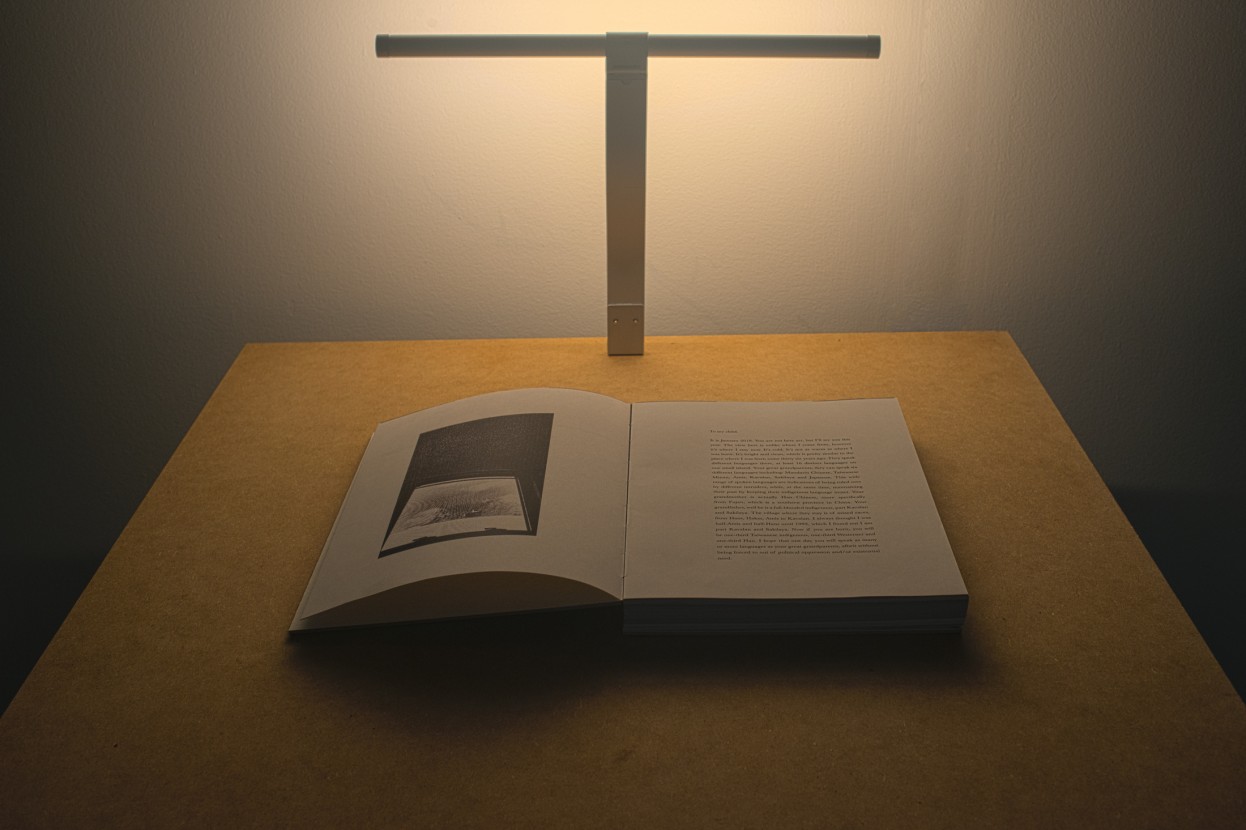
Amongst the many artworks that have struck feelings within me, Wen-Li Chen’s To My Unborn Child (2018) has had a lasting effect. A part of the work consists of a book that Wen-Li printed which includes passages about her family history that she can share with her child, so they know their heritage. My own works revolve around personal struggles with family history and loss of culture. Seeing Wen-Li’s work spoke deeply to me as I related to her efforts to preserve her family history.
Art education for me has become teaching students how to understand and appreciate their subjectivities. In the midst of much standardization and a focus on ‘objectivity’ that risk “alienat[ing] students from their own inner lives” (Palmer, 2002, p. 9), I think the arts and art education provide students various ways to develop their own subjectivity, understand their connection to others and explore new perspectives from a place of empathy – or in the words of Parker Palmer “engage students’ hearts” (2002, p. 10).
In art education, I think it is important to show students the varied ways ideas can be explored and manifested. Before I took art history courses, I had a narrow idea of what art should be and look like. Looking at pieces of art and never knowing the concepts behind them stressed the aesthetic value over meaning and if I encountered artwork that did not look how I expected, I dismissed it. Looking at different varieties and mediums of work is important. It not only shows students how art can manifest, but also teaches students how to learn from every encounter with a work.
I still remember one of those encounters while visiting the Vancouver Art Gallery and connecting so strongly with the piece Aidagara (2017) by Navarana Igloliorte featuring Ayumi Goto. The videowork shows Goto walking along the Stanley Park rock wall, hands roving across its surface, while her eyes are closed. I felt a strong sense of emotion watching this work, as Goto acknowledged and thanked this rock wall for absorbing her sorrows when she was listening to testimonies of residential school survivors. Goto was embracing her subjectivity and her relation to the rock wall and the survivors of residential schools. My aim is that, in teaching students how to be open to learning from art, they can learn to be open to what else the world will say to them – keeping in “dialogue with the world” (Biesta, 2019).
Alongside learning techniques and different styles of art making, critically building concepts for pieces and doing research are important skills too. I value focusing on concepts, questions, and intentions. Making the work and generating ideas mingle, but I would like students to examine their motivations. Experimentation and exploration are encouraged as well, so that students can get a sense of different mediums and find out what techniques they like and can improve on. To support relational and collaborative learning, I value moments when students share ideas and constructive critiques with one another. For me, group discussions were the most helpful to develop my thinking and see what and how others were thinking as well.
Feature image: Wen-Li Chen. Zhu Pu, 2018; artist book. Courtesy of Richmond Art Gallery. Photo: Michael Love.
References
Biesta, B. (Sept. 1, 2019). Trying to be at home in the world. New parameters for arteducation. https://www.artlink.com.au/articles/4781/trying-to-be-at-home-in-the-world-new-parameters-f/
Palmer, P. (2002). The Heart of a teacher: Identity and integrity in teaching. This text is an adaptation of the first chapter in The Courage to Teach: Exploring the Inner Landscape of a Teacher’s Life. Jossey-Bass Ed. http://www.couragerenewal.org/PDFs/Parker-Palmer_The-Heart-of-a-Teacher.pdf

