Before spring break, I introduced to you all an artist named Gu Xiong (watch the video for a refresher – it’s a really awesome video by CBC Arts). We went over his book The Yellow Pear and discussed the journey of Gu’s life and his art practice. At the time, we discussed works that he’d made earlier on in his life but I never went over with you what he has been working on in recent years. Turns out, it fits right in with your current assignment!
“Agriculture Minister Marie-Claude Bibeau says Canadians could see higher prices and less variety of food on store shelves this year.” –The Canadian Press
Ms. Clark gave you this assignment to grow your own food plants because of the effect COVID-19 has had on food production. She explained that since many agricultural workers (those who work on farms) come from Central America, and travel has been impacted by COVID-19, food production and distribution have been somewhat interrupted. At this time when many people are cooking from home, there is a high demand for produce, so farms have to do their best to meet that demand.
Migrant workers, those who move to another country to work temporarily, contribute a lot to Canadian agriculture. Many take jobs to work on Canadian farms for the growing seasons and this year is no different…Except that it is.
Benjamin Shingler of CBC news interviewed Guy Pouliot, who owns a strawberry field in Quebec. In the interview Guy said, “I know there are citizens here who are worried foreign workers will come here with the virus, but I think the foreign workers are even more worried they will get the virus here.”
Migrant workers are an under-appreciated, hardly recognized, essential group of individuals in Canada. Many leave their families and homes behind to work long hours on Canadian farms so that food can be distrubuted across the country and beyond.
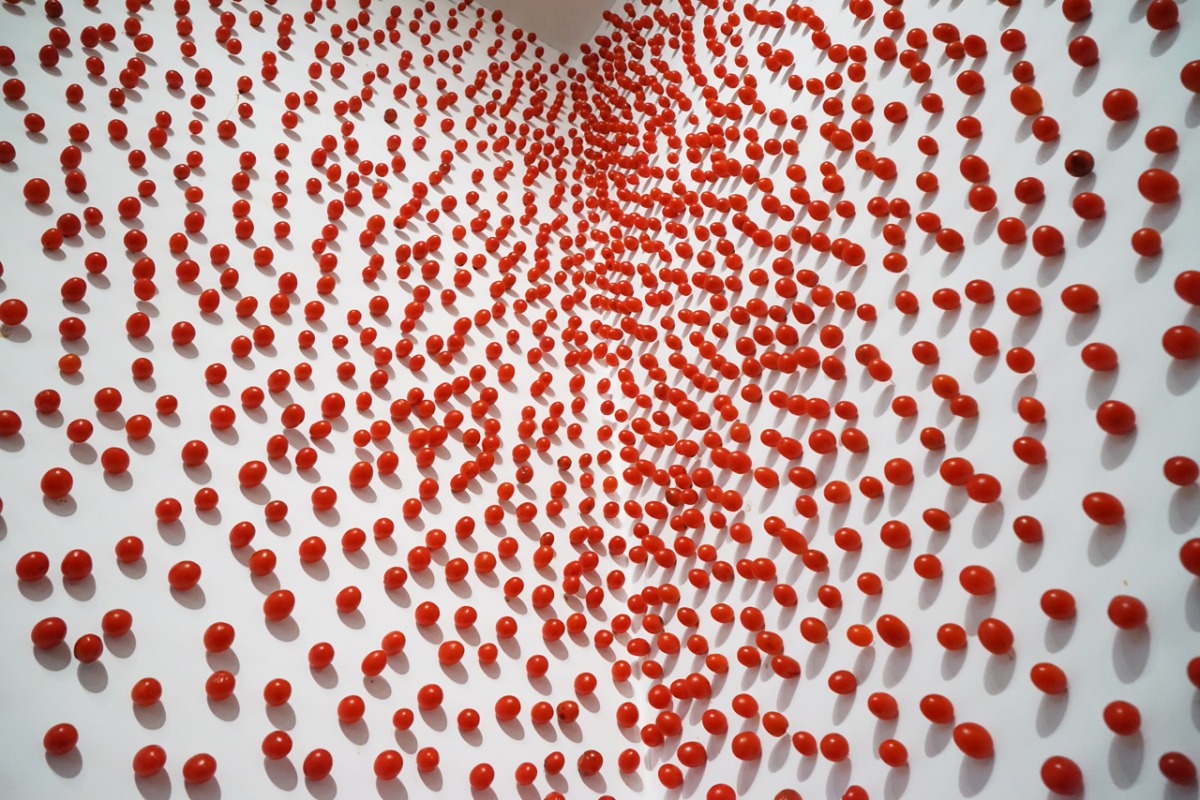
Gu Xiong has worked on a few projects focusing on the stories and journeys of migrant workers. For his piece titled Invisible in the Light V (2014), Gu interviewed migrant workers across Canada. He came to realize that packages for the food produced on the farm would say “Produced in Canada” but made no mention to who helped produce and package those products. That simple statement of where the food was made failed to acknowledge the many different peoples from different cultures who were essential to the making of that product. One such product was tomatoes.
For the art piece, Gu pinned many tomatoes to the white walls of a gallery (pictured here), representing the many individuals and countries that are hardly acknowledged in the process of bringing food to Canadian homes. Imagine the smell of tomato in the room, the drops of tomato juice on the gallery floor. This piece filled the entire room with the presence of tomatoes! By doing so, Gu brought awareness to the migrant workers and their struggles.
When you go to the grocery store, or your parents or guardians bring home groceries, think about who grew them and where they came from. Take a moment to appreciate the many people involved in bringing those groceries to your table, and think about all their different stories and journeys.
This time of COVID-19 has really shown how much people rely on each other and how much we should appreciate everyone around us!